
NSI-Regulations-Annex-1-Definitions-Issue-2-July-2017
The document “NSI-Regulations-Annex-1-Definitions-Issue-2-July-2017” provides a comprehensive list of definitions relevant to the regulations governing NSI approved companies. Key terms include ‘Adjudicator,’ ‘Certification body,’ ‘NSI approval,’ and various types of services related to fire, security, and facilities management. This annex serves as a foundational reference for understanding the terminology used within the NSI regulatory framework.
Read MoreNSI-Regulations-Annex-2-Issue-4-NSI-Schemes-Aug-2020-1
The document “NSI Regulations Annex 2 Issue 4” outlines the various types of approvals available for NSI Approved Companies in the fire, security, and facilities management sectors. It details the scope of company activities and the levels of approval (Gold or Silver) across multiple schemes, including Electronic Security Systems, Guarding Services, Alarm Receiving Centres, and various fire safety and management systems. This document serves as a guideline for companies seeking NSI certification and compliance.
Read MoreNSI-Regulations-Annex-3-Issue-2-Fees-and-Costs-Feb-2021-1
The document titled “NSI-Regulations-Annex-3-Issue-2-Fees-and-Costs-Feb-2021-1” outlines the maximum limits for certain fees and costs applicable to NSI Approved Companies. Key points include a cancellation fee capped at £1,500 plus VAT for each working man-day lost, an appeal deposit not exceeding £3,000 plus VAT, and a maximum award of costs against a company set at £5,000, subject to any retained appeal deposit.
Read MoreFSF 210 Information-required-for-Fire-Project-Files
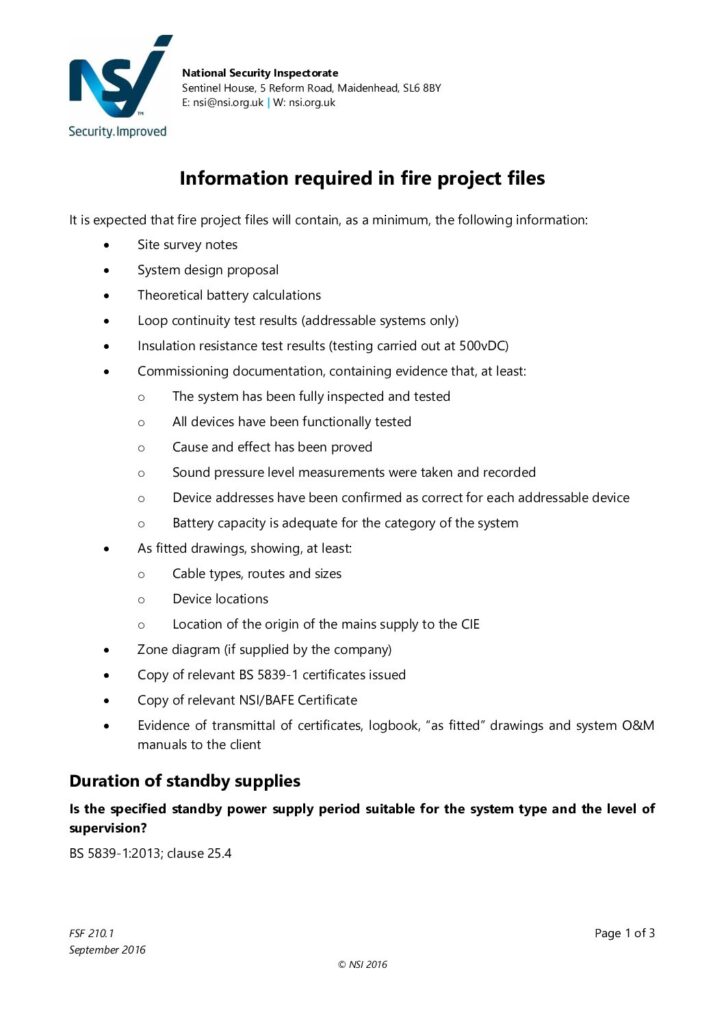
The document outlines the essential information required for fire project files, including site survey notes, system design proposals, test results, commissioning documentation, and as-fitted drawings. It emphasizes the need for adequate battery standby capacity based on system categories, ensuring operational readiness during power outages. Additionally, it provides guidelines for calculating the minimum battery capacity necessary to maintain system functionality and provide evacuation signals during emergencies.
Read MoreNCP-104A-Issue-1-NCP-104.3-System-Design-Specification-Template-Dec-17-rev-Jun-2020
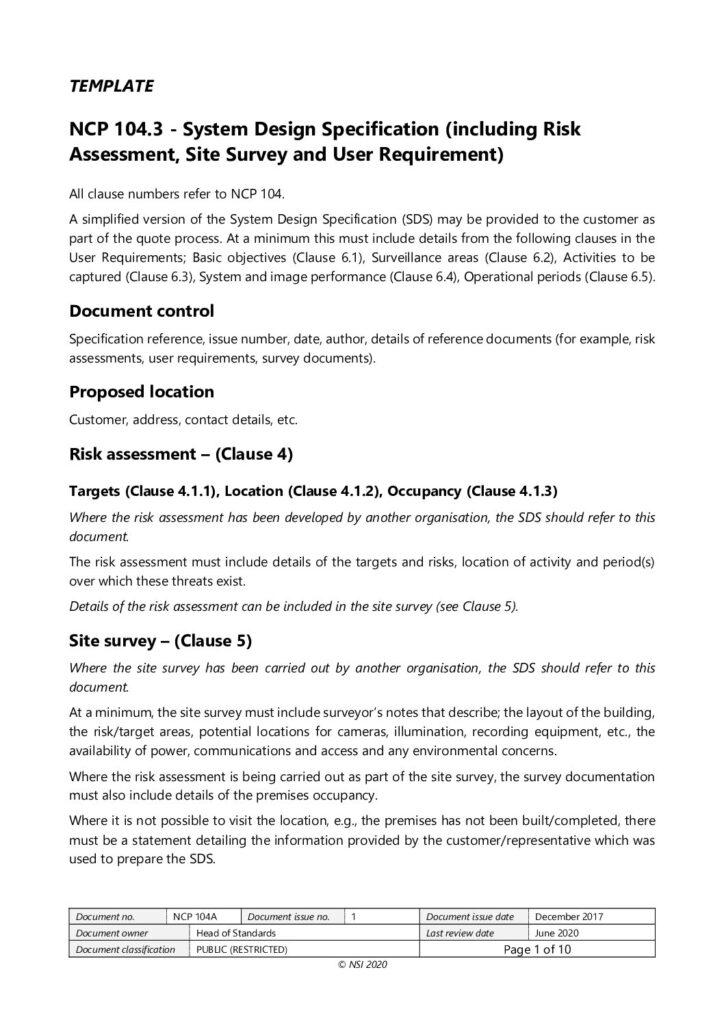
The document titled “NCP-104A-Issue-1-NCP-104.3-System-Design-Specification-Template-Dec-17-rev-Jun-2020” serves as a template for creating a System Design Specification (SDS) that includes essential components such as Risk Assessment, Site Survey, and User Requirements. It outlines the necessary clauses to be addressed, including objectives, surveillance areas, system performance, and legal considerations, ensuring comprehensive documentation for security system design and implementation. The template also emphasizes the importance of validating user requirements and integrating risk assessments and site surveys into the design process.
Read MoreNCP-104B.1-NCP-104.3-System-Design-Specification-Template-Worked-Example-Jul-18-rev-Jun-2020
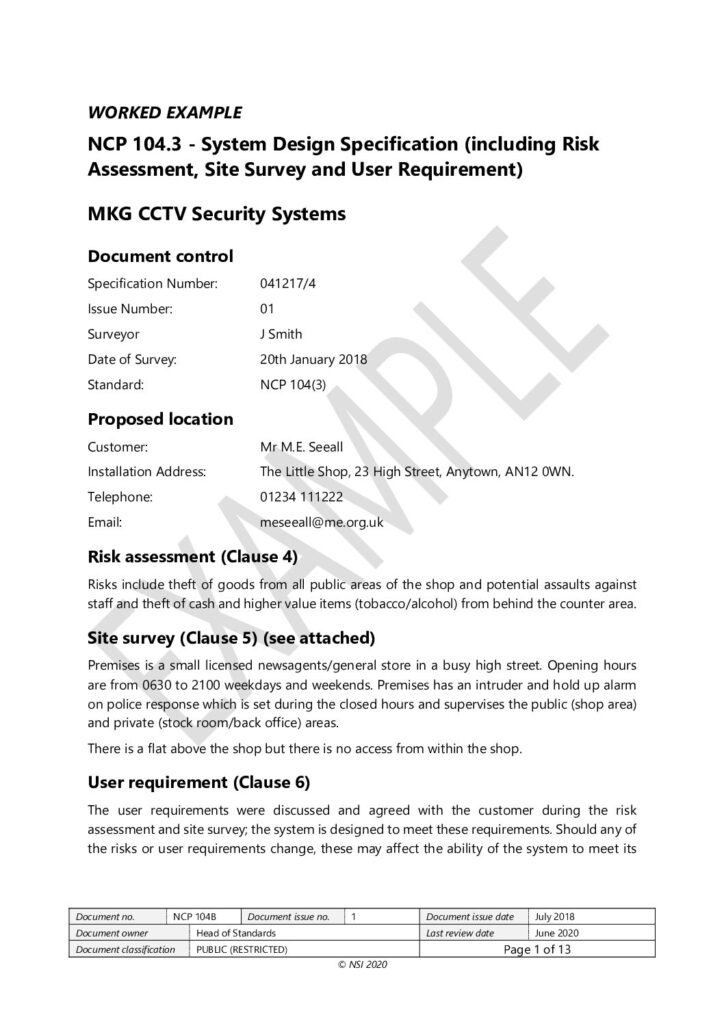
The document “NCP-104B.1-NCP-104.3-System-Design-Specification-Template-Worked-Example-Jul-18-rev-Jun-2020” provides a comprehensive worked example of a System Design Specification (SDS) for a CCTV security system at a retail location. It includes detailed sections on risk assessment, site survey, user requirements, and system design, outlining the necessary equipment, operational parameters, and compliance with data protection regulations. The document serves as a template for developing specifications tailored to similar security system installations.
Read MoreNCP-104C.1-NCP-104.3-System-Design-Specification-for-Small-CCTV-Systems-WORKED-EXAMPLE-Nov-2020
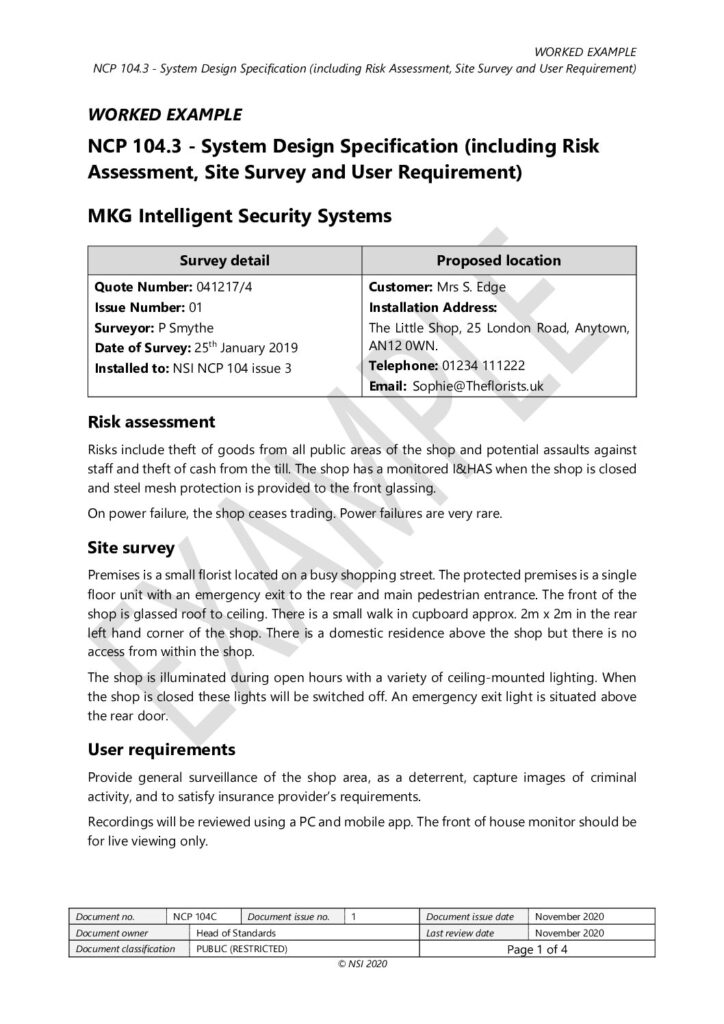
The document “NCP-104C.1-NCP-104.3-System-Design-Specification-for-Small-CCTV-Systems” outlines a comprehensive system design specification for a small CCTV installation at a florist shop, including a risk assessment, site survey, and user requirements. It details the placement and specifications of two surveillance cameras, a network video recorder, and a monitoring system, along with training and maintenance recommendations. The design aims to enhance security by providing general surveillance, deterring criminal activity, and meeting insurance requirements.
Read MoreNCP-109A.2-Specification-for-an-Electronic-Access-Control-System-WORKED-EXAMPLE-Sept-2021
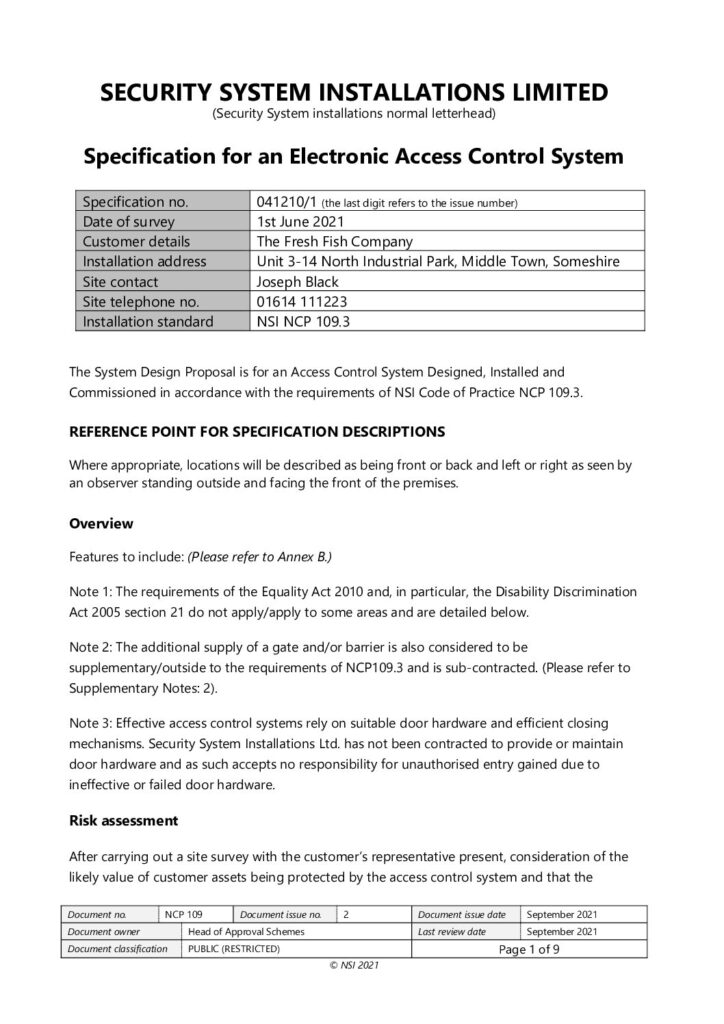
The document “NCP-109A.2-Specification-for-an-Electronic-Access-Control-System-WORKED-EXAMPLE-Sept-2021” outlines the specifications for an electronic access control system designed for The Fresh Fish Company, adhering to NSI Code of Practice NCP 109.3. It details the installation requirements, including various access points with specific locking mechanisms, emergency exit provisions, and system operation during power failures, while also addressing compliance with relevant legislation such as the Disability Discrimination Act. Additionally, it emphasizes the importance of suitable door hardware and outlines the responsibilities of both the installation company and the customer regarding system maintenance and security.
Read MoreNSF-272-Marking-Table-for-PD-6662-NCP-120-Preventative-Maintenance
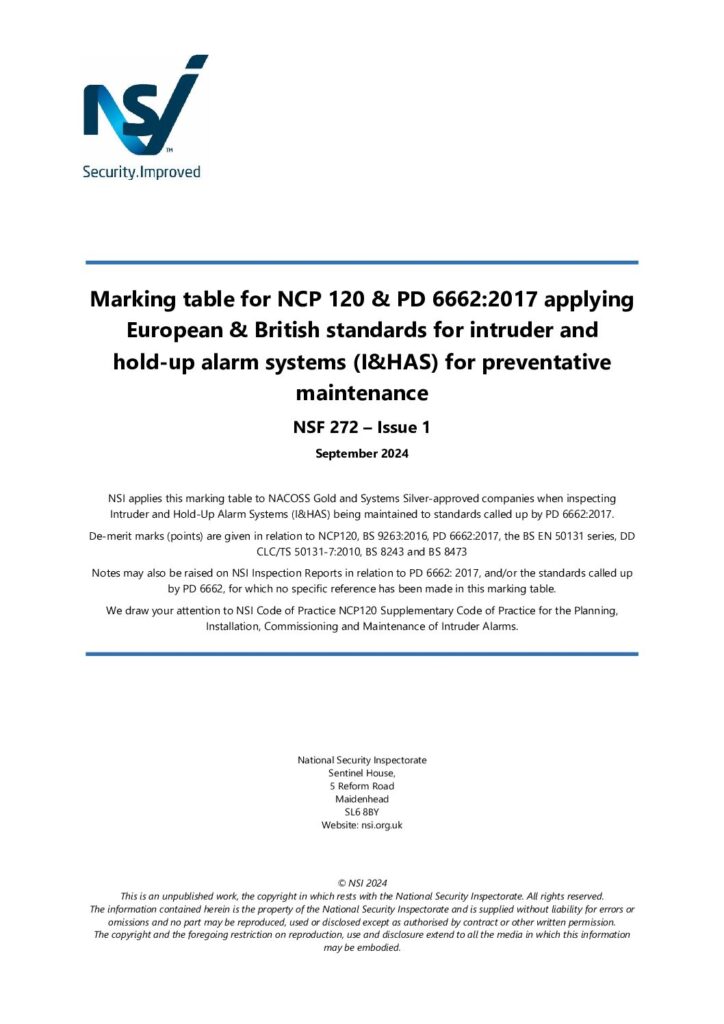
The document titled “Marking-Table-for-PD-6662-NCP-120-Preventative-Maintenance” outlines the marking criteria for inspecting Intruder and Hold-Up Alarm Systems (I&HAS) in accordance with PD 6662:2017 and related standards. It provides a structured marking table divided into five sections, detailing specific maintenance requirements, testing protocols, and visual inspections, with points assigned for deviations from established standards. The document serves as a guideline for NSI inspectors to evaluate compliance and determine the need for re-inspection based on the grading system.
Read MoreNSF-271.2-Marking-Table-for-NCP-109-Access-Control-Systems-June-2021
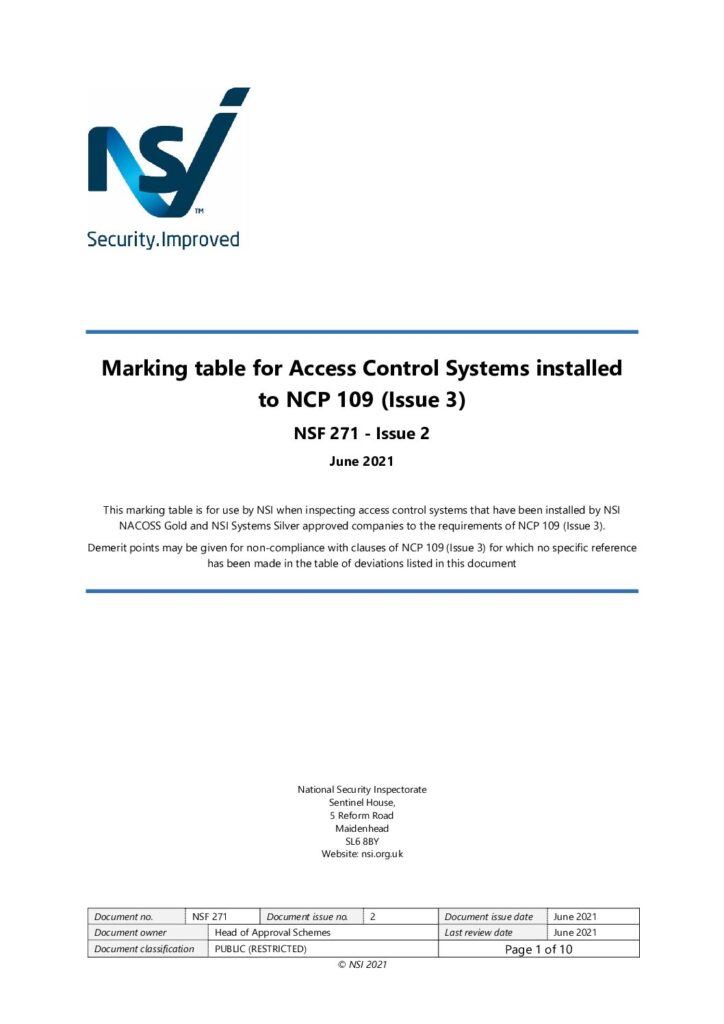
The document “NSF-271.2-Marking-Table-for-NCP-109-Access-Control-Systems-June-2021” provides a detailed marking table for inspecting access control systems installed by NSI-approved companies in accordance with NCP 109 (Issue 3). It outlines various sections with specific criteria, assigns point values for compliance deviations, and establishes a grading system based on total points awarded. The document serves as a guideline for assessing adherence to safety, security, and operational standards in access control systems.
Read More