
NSI-Regulations-Annex-1-Definitions-Issue-2-July-2017
The document “NSI-Regulations-Annex-1-Definitions-Issue-2-July-2017” provides a comprehensive list of definitions relevant to the regulations governing NSI approved companies. Key terms include ‘Adjudicator,’ ‘Certification body,’ ‘NSI approval,’ and various types of services related to fire, security, and facilities management. This annex serves as a foundational reference for understanding the terminology used within the NSI regulatory framework.
Read MoreNSI-Regulations-Annex-2-Issue-4-NSI-Schemes-Aug-2020-1
The document “NSI Regulations Annex 2 Issue 4” outlines the various types of approvals available for NSI Approved Companies in the fire, security, and facilities management sectors. It details the scope of company activities and the levels of approval (Gold or Silver) across multiple schemes, including Electronic Security Systems, Guarding Services, Alarm Receiving Centres, and various fire safety and management systems. This document serves as a guideline for companies seeking NSI certification and compliance.
Read MoreNSI-Regulations-Annex-3-Issue-2-Fees-and-Costs-Feb-2021-1
The document titled “NSI-Regulations-Annex-3-Issue-2-Fees-and-Costs-Feb-2021-1” outlines the maximum limits for certain fees and costs applicable to NSI Approved Companies. Key points include a cancellation fee capped at £1,500 plus VAT for each working man-day lost, an appeal deposit not exceeding £3,000 plus VAT, and a maximum award of costs against a company set at £5,000, subject to any retained appeal deposit.
Read MoreNSF-713.2-Buddy-Agreement-Form-June-2024 (1)
The “NSF-713.2-Buddy-Agreement-Form-June-2024” outlines the terms and conditions for establishing a buddy system within the NSF framework. It includes sections on participant responsibilities, confidentiality agreements, and guidelines for effective collaboration. This form is intended to facilitate support and mentorship among participants in NSF programs.
Read MoreOP2-085.1-Requirement-for-use-of-a-Virtual-Office-Jun-2024
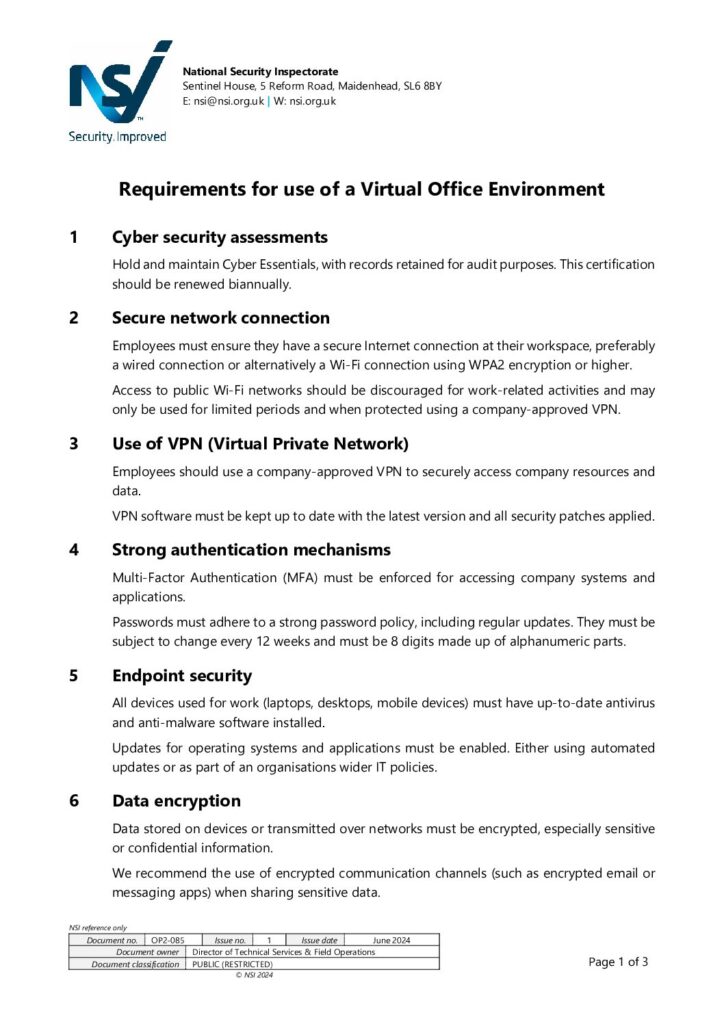
The document “OP2-085.1-Requirement-for-use-of-a-Virtual-Office-Jun-2024” outlines essential cybersecurity and operational requirements for employees working in a virtual office environment. Key points include maintaining Cyber Essentials certification, ensuring secure internet connections, implementing multi-factor authentication, and using company-approved cloud storage for data. Additionally, it emphasizes the importance of regular security training, incident response planning, and compliance with data protection regulations.
Read MoreNSI-Technical-Bulletin-No-0029-Guidance-on-the-application-of-BS-8418-2015
NSI Technical Bulletin No. 0029 provides guidance on the application of BS 8418:2015, which outlines the installation and remote monitoring of detector-activated CCTV systems. The bulletin highlights significant changes from the previous standard, including terminology updates, the introduction of new compliance requirements, and the consolidation of fault detection and tamper indication protocols. Compliance with the new standard is mandatory for organizations seeking NSI approval, and the document emphasizes the importance of collaboration between CCTV companies, customers, and remote video response centers (RVRCs) in meeting these updated requirements. Manual review is recommended for complete details.
Read MoreTech-Bulletin-0007-BS5979-2007-re-layered-security
NSI Technical Bulletin No. 0007 provides guidance on the application of the last paragraph of sub-clause 5.1.1.3 of BS 5979:2007, specifically regarding the use of layered security for Alarm Receiving Centres (ARCs) operational before June 30, 2008. It outlines the criteria for demonstrating that an equivalent standard of protection can be achieved through layered security methods, as opposed to traditional physical security measures, and details the inspection process for NSI Inspectors assessing compliance for ARC Gold approval. The bulletin also emphasizes the importance of evaluating the effectiveness of layered security in resisting or delaying criminal attacks. Manual review recommended for complete details.
Read MoreTech-Bulletin-0011-ISO-9001-2008
NSI Technical Bulletin 0011 provides guidance on implementing the BS EN ISO 9001:2008 standard for quality management systems, which supersedes the 2000 edition. Effective immediately, all NSI Gold approved organizations and applicants must comply with the new standard, with existing certificates from the 2000 edition valid until November 14, 2010. The bulletin outlines key changes in the standard, emphasizes the importance of addressing legal requirements, and clarifies the expectations for both new applicants and existing organizations regarding their transition to the updated standard. Manual review is recommended for complete details on specific requirements and changes.
Read MoreTech-Bulletin-0013-PD-6662-2010
NSI Technical Bulletin No. 0013 provides guidance on the implementation of PD 6662: 2010, which outlines the application of European standards for intrusion and hold-up alarm systems. Key changes include the transition period allowing installation under the previous PD until May 31, 2012, and the requirement for all systems to comply with the new PD from June 1, 2012. The bulletin details the new standards called up by the PD, including BS EN 50131 series and BS 8243: 2010, which must be adhered to for compliance and maintaining NSI approvals. Manual review is recommended for complete details on specific requirements and standards.
Read MoreTech-Bulletin-0018-BS-8418-2010
NSI Technical Bulletin No. 0018 provides guidance on the application of BS 8418:2010, which outlines the installation and remote monitoring requirements for detector-activated CCTV systems. Key points include the transition period for compliance, the necessity for documented agreements between installers, owners, and remote video response centers (RVRCs), and specific technical requirements such as power supply standards and maintenance protocols. The bulletin emphasizes the importance of collaboration among all parties to ensure effective system design, installation, and ongoing operation in accordance with the new standard. Manual review may be needed for complete details.
Read More