NSF-272-Marking-Table-for-PD-6662-NCP-120-Preventative-Maintenance
The document titled “Marking-Table-for-PD-6662-NCP-120-Preventative-Maintenance” outlines the marking criteria for inspecting Intruder and Hold-Up Alarm Systems (I&HAS) in accordance with PD 6662:2017 and related standards. It provides a structured marking table divided into five sections, detailing specific maintenance requirements, testing protocols, and visual inspections, with points assigned for deviations from established standards. The document serves as a guideline for NSI inspectors to evaluate compliance and determine the need for re-inspection based on the grading system.
Read MoreNSF-271.2-Marking-Table-for-NCP-109-Access-Control-Systems-June-2021
The document “NSF-271.2-Marking-Table-for-NCP-109-Access-Control-Systems-June-2021” provides a detailed marking table for inspecting access control systems installed by NSI-approved companies in accordance with NCP 109 (Issue 3). It outlines various sections with specific criteria, assigns point values for compliance deviations, and establishes a grading system based on total points awarded. The document serves as a guideline for assessing adherence to safety, security, and operational standards in access control systems.
Read MoreNSF-713.2-Buddy-Agreement-Form-June-2024 (1)
The “NSF-713.2-Buddy-Agreement-Form-June-2024” outlines the terms and conditions for establishing a buddy system within the NSF framework. It includes sections on participant responsibilities, confidentiality agreements, and guidelines for effective collaboration. This form is intended to facilitate support and mentorship among participants in NSF programs.
Read MoreOP2-085.1-Requirement-for-use-of-a-Virtual-Office-Jun-2024
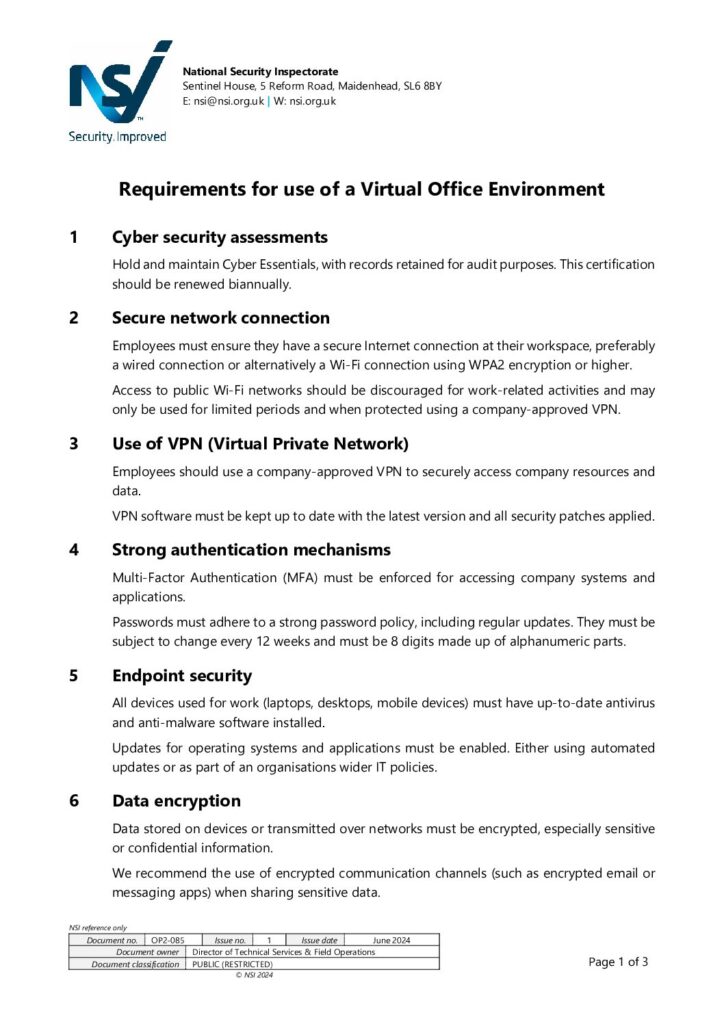
The document “OP2-085.1-Requirement-for-use-of-a-Virtual-Office-Jun-2024” outlines essential cybersecurity and operational requirements for employees working in a virtual office environment. Key points include maintaining Cyber Essentials certification, ensuring secure internet connections, implementing multi-factor authentication, and using company-approved cloud storage for data. Additionally, it emphasizes the importance of regular security training, incident response planning, and compliance with data protection regulations.
Read MoreNSF-700.15-NACOSS-Gold-and-Systems-Silver-Scheme-Standards-Aug-2021
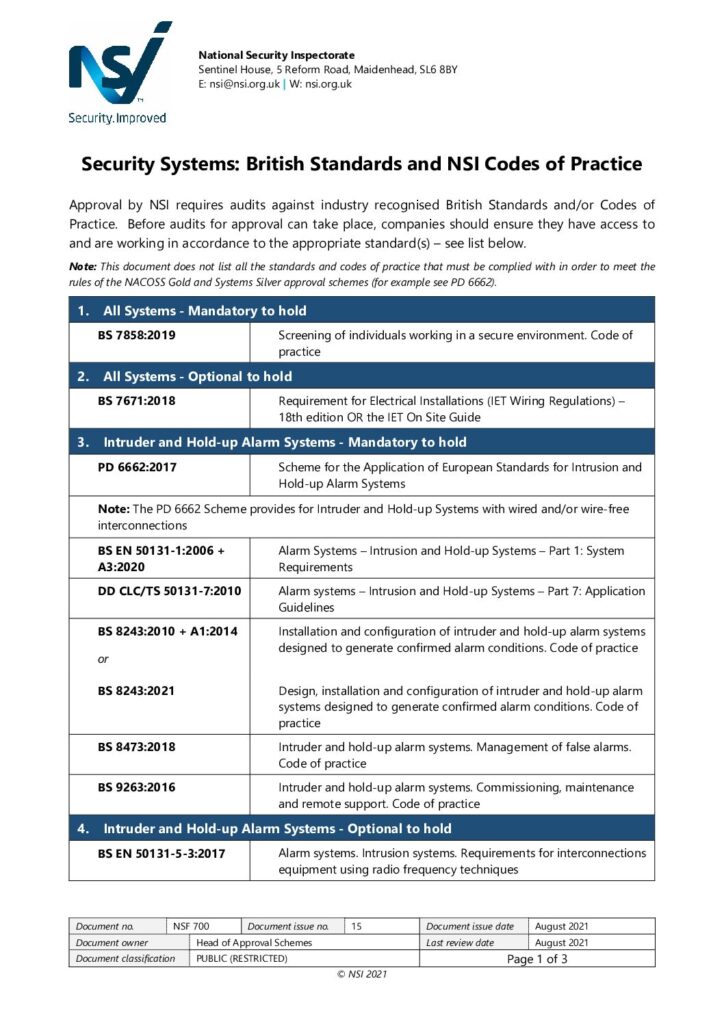
The document “NSF-700.15-NACOSS-Gold-and-Systems-Silver-Scheme-Standards-Aug-2021” outlines the mandatory and optional British Standards and NSI Codes of Practice required for companies seeking approval under the NACOSS Gold and Systems Silver schemes. It specifies essential standards for various security systems, including intruder alarms, CCTV, and access control, and provides guidance on compliance and the necessary audits for approval. Additionally, it includes information on accessing relevant standards and codes of practice for NSI-approved companies.
Read MoreNSI-Technical-Bulletin-No.-0059-Publication-of-BS-8243_2021
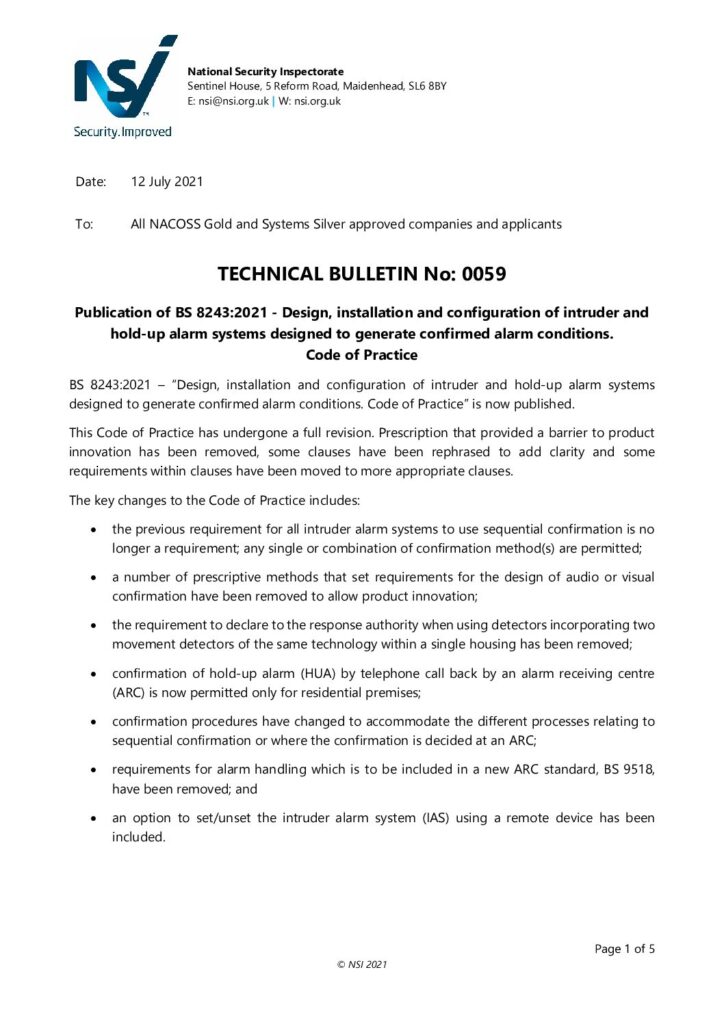
The document is a Technical Bulletin from the National Security Inspectorate announcing the publication of BS 8243:2021, which outlines the design, installation, and configuration of intruder and hold-up alarm systems intended to generate confirmed alarm conditions. Key updates include the removal of the mandatory sequential confirmation requirement, the allowance for various confirmation methods, and changes to alarm handling procedures. A 12-month transition period is established for companies to adapt to the new standards, which took effect on June 30, 2021. Manual review recommended for complete details.
Read MoreNSI-Technical-Bulletin-No.-0060-Publication-of-BS-8418_2021
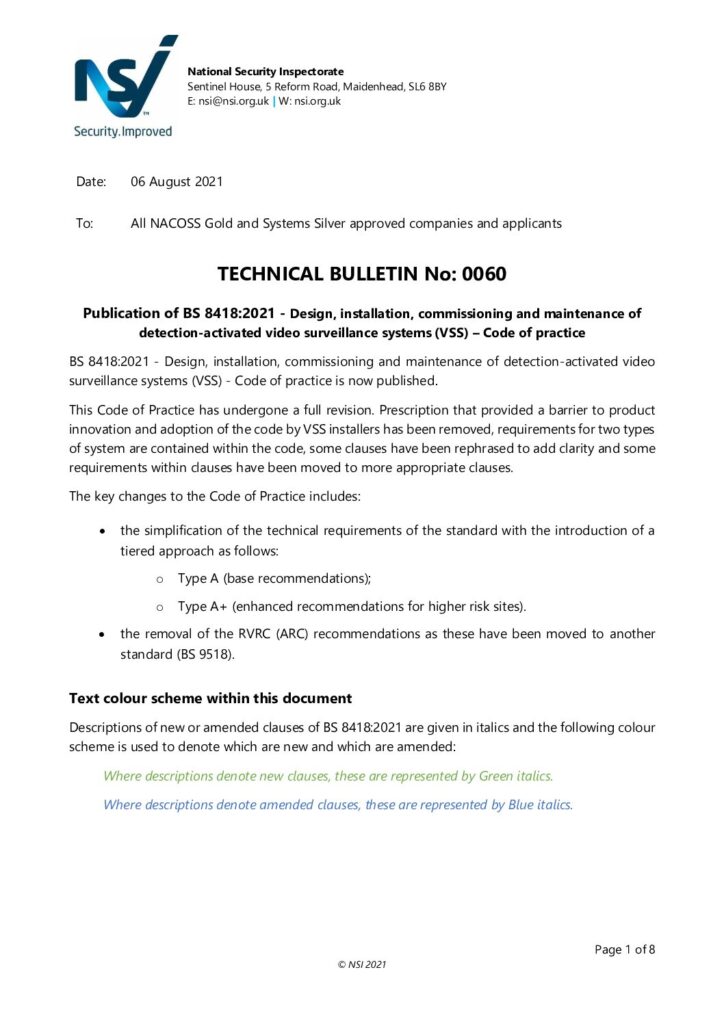
The document outlines the publication of BS 8418:2021, which serves as a Code of Practice for the design, installation, commissioning, and maintenance of detection-activated video surveillance systems (VSS). Key updates include a tiered approach to system recommendations, the removal of certain recommendations now covered by BS 9518, and a 12-month transition period for compliance with the new standard, effective from July 31, 2021. Significant changes to clauses and definitions are highlighted, with a focus on simplifying technical requirements and enhancing clarity. Manual review may be needed for complete details on all changes introduced.
Read MoreNSI-Technical-Bulletin-No-0029-Guidance-on-the-application-of-BS-8418-2015
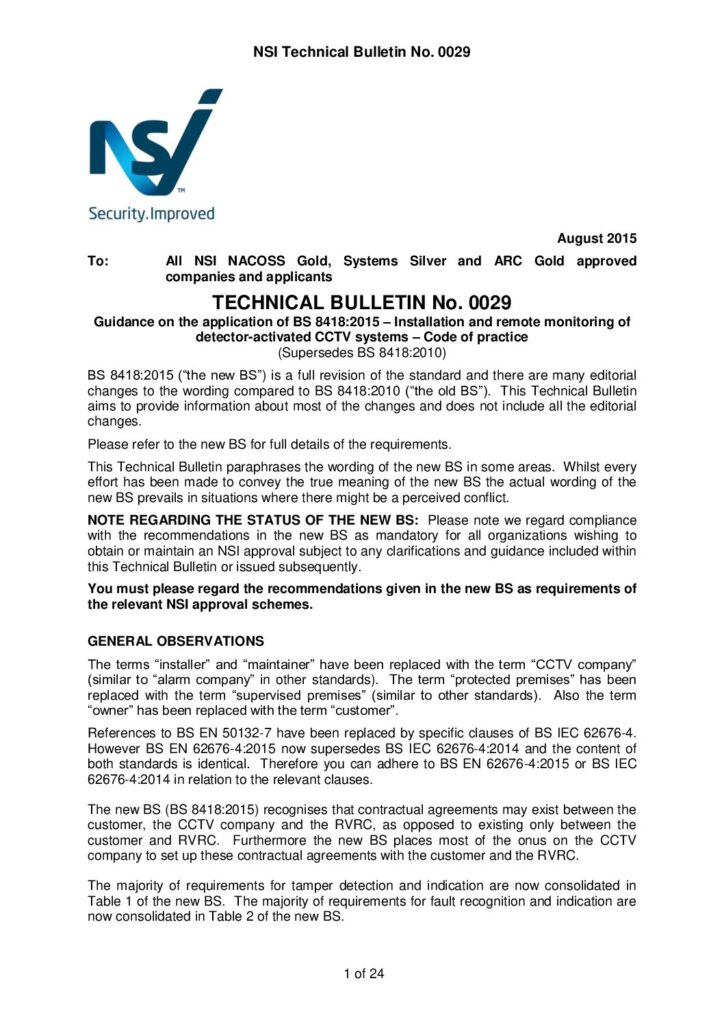
NSI Technical Bulletin No. 0029 provides guidance on the application of BS 8418:2015, which outlines the installation and remote monitoring of detector-activated CCTV systems. The bulletin highlights significant changes from the previous standard, including terminology updates, the introduction of new compliance requirements, and the consolidation of fault detection and tamper indication protocols. Compliance with the new standard is mandatory for organizations seeking NSI approval, and the document emphasizes the importance of collaboration between CCTV companies, customers, and remote video response centers (RVRCs) in meeting these updated requirements. Manual review is recommended for complete details.
Read MoreNSI-Technical-Bulletin-No-0040-PD-6662-2017
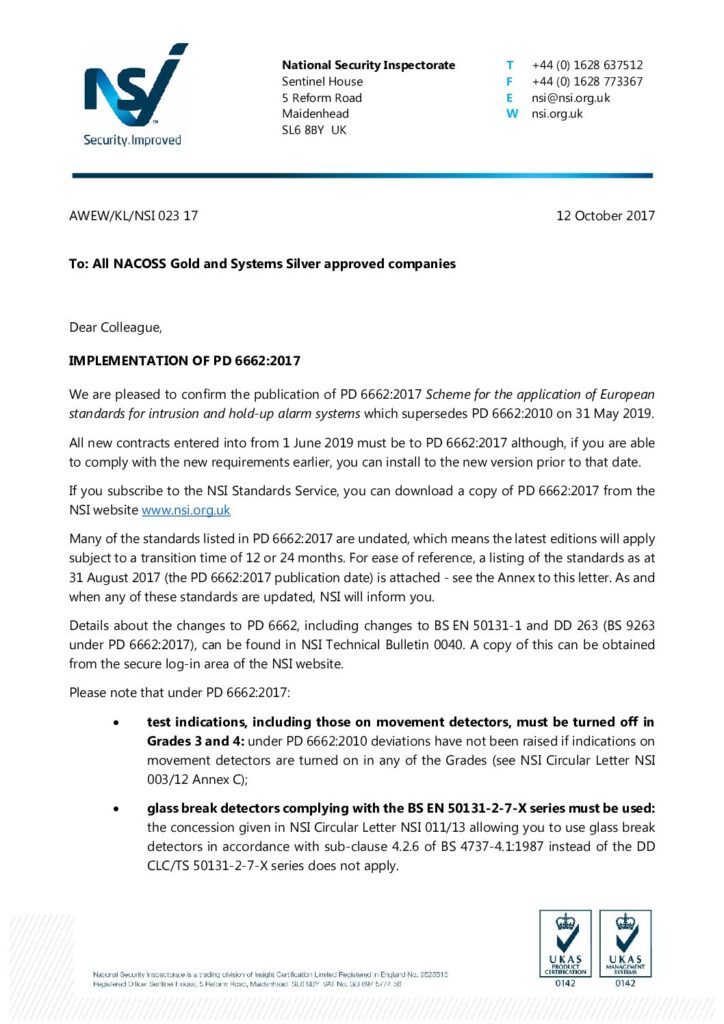
This document, NSI Technical Bulletin No. 0040, provides guidance on the implementation of PD 6662:2017, which supersedes the previous PD 6662:2010 standard for intrusion and hold-up alarm systems in the UK. It outlines the requirements for the design, installation, commissioning, and maintenance of these systems, referencing relevant British and European standards. The bulletin emphasizes that compliance with PD 6662:2017 is mandatory for companies seeking NSI approval and details the transition period for existing and applicant companies to align with the new standards by June 1, 2019. Manual review may be needed for complete details on specific changes and requirements.
Read MoreNSI-Technical-Bulletin-No-0043-BS-8418-2015-A1-2017
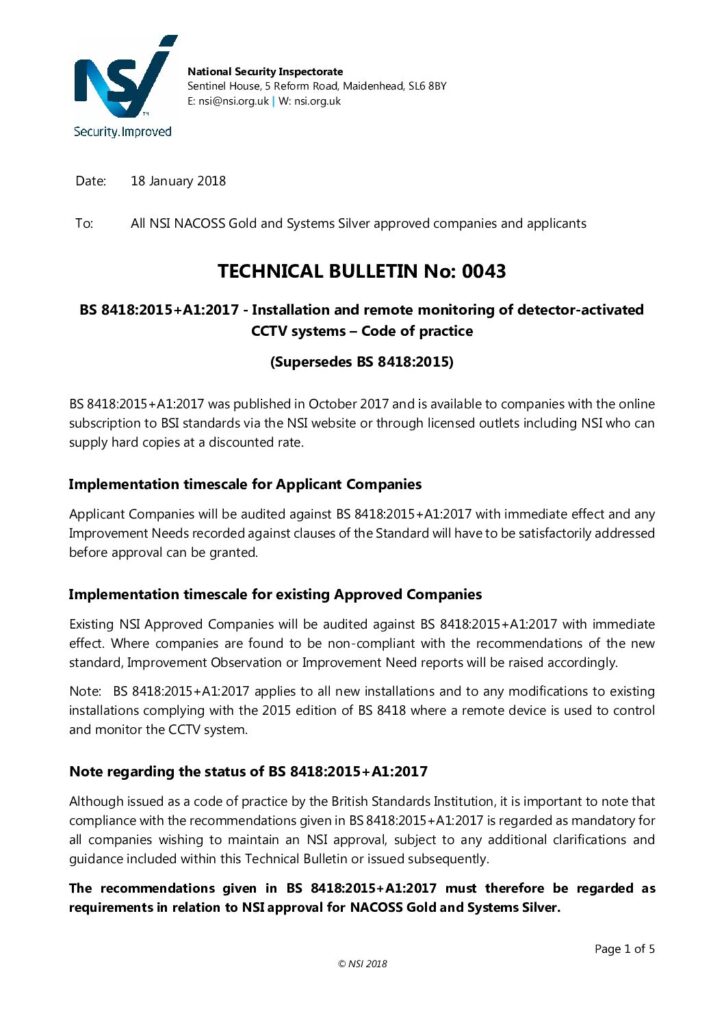
This Technical Bulletin (No. 0043) outlines the updates to the BS 8418:2015+A1:2017 standard for the installation and remote monitoring of detector-activated CCTV systems, which is now mandatory for NSI NACOSS Gold and Systems Silver approved companies. The document details the immediate implementation requirements for both applicant and existing approved companies, emphasizing compliance with the new standard for all installations and modifications. Key changes include new definitions, updated procedures for setting and unsetting systems using remote devices, and the necessity of adhering to cyber security best practices. Manual review may be needed for complete details on specific clauses and requirements.
Read More